
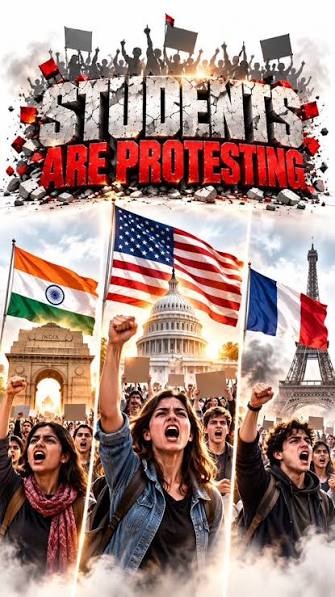
What motivates big protest movements like the ones occurring in France, India, and the “No Kings” demonstrations in the U.S.? Are there common demands? Have generational shifts led to more protests?
When mass protests and large demonstrations break out, governments have responded with counter campaigns or violence to delegitimize protesters. What happens when governments counter movements? What constitutes a successful protest movement? [ dur: 58mins. ]
- David S. Meyer is Professor of Sociology, Political Science, and Planning, Policy, and Design at UC Irvine. He is the author of The Politics of Protest: Social Movements in America and co-editor of The Resistance: The Dawn of the Anti-Trump Opposition Movement. His blog is Politics Outdoors.
- Michael T. Heaney is Lecturer in Politics and Research Methods at the University of Glasgow. He is a co-author with Fabio Rojas of the book Party in the Street: The Antiwar Movement and the Democratic Party after 9/11 (Cambridge University Press, 2015). With Melody Shemtov and Marco Roldán he is creator, producer, and writer of a documentary film, The Activists: War, Peace, and Politics in the Streets (Bullfrog Films, 2017).
- Jeremy Pressman is Professor of Political Science at University of Connecticut. He co-founded the Crowd Counting Consortium, an event counting project that has tallied and made publicly available data on all manner of protests in the United States since 2017. He is the author of the book The sword is not enough: Arabs, Israelis, and the limits of military force (Manchester, UK: Manchester University Press, 2020). Pressman questions the over-reliance on military force and highlights the negative military and political consequences such as greater insecurity, Warring Friends: Alliance Restraint in International Politics (Ithaca, NY: Cornell University Press, 2008) and co-author with Geoffrey Kemp, Point of No Return: The Deadly Struggle for Middle East Peace (Washington, DC: Brookings Institution Press, 1997).
This program is produced by Doug Becker, Maria Armoudian, Ankine Aghassian, Anna Lapin and Sudd Dongre.
Politics and Activism, France, India, US, protests
Podcast: Play in new window | Download (Duration: 58:01 — 53.1MB) | Embed
Subscribe: Apple Podcasts | Spotify | RSS